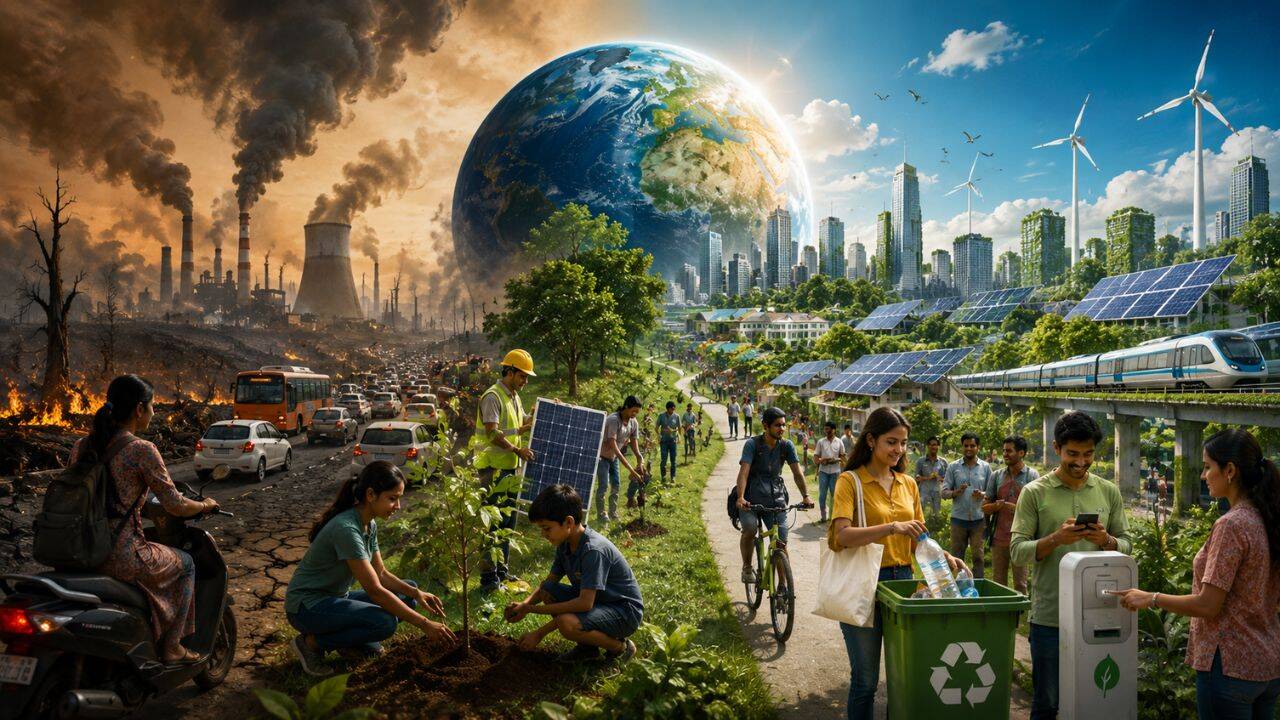
India cannot achieve net-zero through government action alone. Climate policy asks citizens to change their behaviour every day — consume less energy, use cleaner transport, reduce waste, conserve resources — yet rarely rewards them for doing so. That may be the missing link in climate strategy.
For decades, climate action across the world has largely followed a top-down model. Governments establish targets, industries comply with regulations, and citizens are expected to adapt. Yet the cumulative effect of millions of daily decisions — how people travel, consume, build homes, use electricity, or manage resources — ultimately determines climate outcomes.
India’s commitment to achieving net-zero emissions by 2070 will require changes at a scale that regulation alone cannot deliver. Achieving that goal means progressively reducing or offsetting emissions generated across transport, industry, energy systems, agriculture, and everyday economic activity. No state, however capable, can monitor or influence billions of micro-decisions across households, farms, offices, and communities. If climate change is among the defining missions of this century, India possesses a unique advantage: a population of 1.4 billion whose daily choices, if properly incentivized, can become an unparalleled engine of climate action.


The larger question therefore is not simply how governments reduce emissions, but how citizens can become active stakeholders in climate outcomes.
The answer may lie in shifting from compliance to participation — creating systems where climate-positive behaviour generates measurable economic value, transforming emissions reduction from a cost centre into an economic opportunity.
The institutional foundations for such a transition already exist. Through the Energy Conservation (Amendment) Act, 2022, India has initiated a framework for a domestic carbon market. Much of the current discussion around carbon markets, however, focuses on industries and large emitters. That may be too narrow a view.
The larger opportunity may be to democratize the market itself.
Globally, early experiments already point in this direction. China’s “Tanpuhui” or “Carbon Inclusion” initiatives have attempted to encourage lower-carbon lifestyle choices such as public transport use and other environmentally beneficial activities. Scotland similarly experimented with reward-based systems designed to encourage climate-positive behaviour. These efforts remain limited and evolving, but they establish an important principle: environmental participation can be measured, rewarded, and scaled.
The first proof of concept lies in community action.
Consider forest fires. Across many regions, local volunteers, community groups, and self-help networks frequently constitute the first line of ecological defence. Yet despite protecting valuable environmental assets, these efforts often remain uncompensated because of fiscal constraints.
Emerging technologies offer another possibility. Satellite systems and remote sensing can increasingly estimate biomass preserved and emissions avoided through timely interventions. Rather than relying solely on government expenditure, public institutions could function as neutral verifiers while measurable environmental outcomes translate into tradable carbon assets. Communities protecting forests would then become participants in a climate economy rather than unpaid actors performing social service.
The second proof lies in individual behaviour.
Climate policy has traditionally relied on restrictions and mandates. But lasting behavioural shifts often occur when incentives align with personal benefit.
Imagine households receiving carbon rewards for consuming less electricity than regional benchmarks through efficient appliances, better insulation, or low-emission technologies. Consider urban mobility systems where citizens accumulate carbon points through public transport use, shared mobility, or carpooling.
Each action may appear insignificant in isolation. But in a nation of 1.4 billion people, the cumulative effect of millions of such decisions can reshape national emissions trajectories.
The third proof lies in business and industrial systems.
Climate governance within corporations frequently remains compliance-driven, centred on disclosures and regulatory obligations. These are essential but may not be sufficient.
Organizations can increasingly embed sustainability into operational choices that simultaneously reduce costs and emissions: remote work structures where feasible, digital service delivery, energy-efficient infrastructure, and optimized use of physical assets.
Similarly, industrial strategy itself requires longer-term redesign. For new investments — and for existing facilities where technically and economically feasible — locating processing operations closer to raw-material sources can reduce transportation intensity and lower embedded emissions across supply chains. Cleaner technologies, electrification, and circular material flows can further strengthen these gains.
Critics may argue that rewarding decentralized climate actions across millions of participants would create excessive administrative complexity and opportunities for manipulation.
That concern is legitimate.
Yet India’s own digital transformation suggests that distributed systems can operate at extraordinary scale. Digital identities, smart infrastructure, real-time transaction systems, and expanding technology networks increasingly provide the architecture required for decentralized participation. What once appeared administratively impossible may now be operationally feasible.
But technology and carbon markets alone are not the central argument.
Participation is.
Climate transitions succeed when sustainable behaviour becomes personally beneficial rather than administratively imposed. Regulation can establish boundaries, but societies change when incentives align with human behaviour.
If communities gain from protecting ecosystems, households benefit from reducing energy consumption, commuters receive value from cleaner mobility choices, and businesses profit from sustainable practices, environmental responsibility ceases to feel like an external obligation.
India’s population of 1.4 billion is not merely a climate challenge to manage; it is a climate force to mobilize.
India’s climate transition will ultimately not be won in ministries or boardrooms alone. It will be won in kitchens, buses, farms, factories, and communities across the country.
India will reach net-zero not when climate action becomes everyone’s obligation, but when it becomes everyone’s opportunity.
Disclaimer
Views expressed above are the author’s own.
END OF ARTICLE