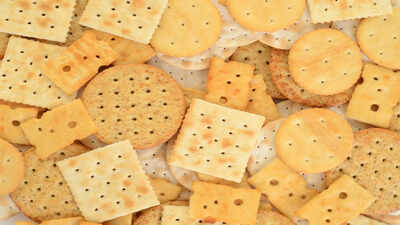

At first glance, the tiny holes in crackers look almost decorative, like some quiet design choice added to make a plain biscuit seem more interesting. But they are doing real work. Those little punctures, known in baking as docking, are one of the simplest reasons a cracker comes out crisp, flat and evenly baked instead of puffed up into something soft, uneven or strangely hollow. It is one of those everyday details most people never question. You open a packet, snap a cracker, and the pattern is just there, as familiar as the crunch itself. Yet behind that neat grid of holes is a small piece of food engineering shaped by steam, heat and physics. Scroll down to read more…
The holes keep the cracker flat
Crackers are made from dough, but unlike bread, they are not meant to rise into airy pillows. The goal is a thin, dry, brittle texture with a clean snap. When dough goes into a hot oven, the moisture inside turns to steam. That steam expands quickly, and without an escape route, it pushes the dough upward. For softer baked goods, that lift is often welcome. For crackers, it is a problem. A cracker that puffs too much loses its signature texture. It becomes uneven, blistered in the wrong way, or too fragile in some spots and too dense in others.

The tiny holes solve that. They give steam a way out during baking, preventing large bubbles from forming beneath the surface. In effect, the holes tell the dough to stay where it is. Instead of ballooning, it dries out evenly and holds its flat shape.
They help the heat move through the dough
A cracker is thin, but it still needs uniform baking. If the surface cooks much faster than the center, the result can be a product that is brown on top but underdone inside, or crisp at the edges and limp in the middle. Docking helps with that too. By puncturing the dough, manufacturers allow heat and moisture to move more evenly through the cracker during baking. That means a more consistent finish from corner to corner, which matters a great deal when the product is expected to crack cleanly every single time. It is a tiny intervention with a big payoff. A few holes can be the difference between a crisp, even biscuit and one that warps, blisters or bakes into an awkwardly uneven shape.
They shape texture, not just appearance
People often think of the holes as purely visual, part of the familiar look of many crackers. But texture is really the point. Cracker makers want a controlled bake, and the holes help create the right internal structure. Without docking, steam pockets can form unpredictably. That can lead to lift in some areas and collapse in others. The final cracker may still be edible, but it will not have that refined, snappy bite that makes a cracker feel crisp rather than chewy.The holes also influence how the cracker breaks. Because the dough is baked with controlled airflow and less trapped moisture, it tends to fracture neatly instead of bending or tearing. That sharp break is part of the appeal. It is what makes crackers feel light rather than heavy.
This is an old baking trick
Docking is not a modern factory invention. Bakers have been pricking dough for centuries. Long before industrial baking lines and automated rollers, people discovered that venting dough mattered. Pie crusts, flatbreads and pastries have all used some version of this technique.

In crackers, the idea became especially important because the product is so thin and dry to begin with. A small change in oven behavior can completely alter the final result. The holes are a practical solution that has survived because it works so well. You could almost think of them as a baker’s quiet restraint. Instead of letting the dough do whatever it wants in the heat, the holes guide it into the shape people expect.
Not every biscuit uses the same pattern
Different crackers and biscuits use different docking styles depending on the recipe and the texture the maker wants. Some have rows of tiny pinpricks. Others have a more pronounced pattern. Some are heavily perforated, while others have only a few marks.The exact pattern is often adjusted for the thickness of the dough, the fat content, the amount of moisture and the oven temperature. A richer dough may behave differently from a lean one. A thicker cracker may need more venting than a thin one. The pattern is less about decoration than about control. That is why the holes can look so uniform. They are not random. They are placed deliberately so the baking process stays predictable at industrial scale, where thousands of identical crackers may pass through the same ovens every hour.
A small detail with a big purpose
The next time you pick up a cracker and notice those tiny holes, you are looking at a solution to a basic baking problem. How do you keep dough flat, crisp and evenly cooked when heat wants to make it puff? The answer, surprisingly enough, is to pierce it. That is what makes the holes so satisfying as a piece of food design. They are invisible in the sense that most people never notice them but essential in the sense that the cracker would not really be a cracker without them. They protect the texture, improve the bake, and preserve the crisp snap that makes the snack feel right. So the tiny holes are not there because someone thought the biscuit needed patterning. They are there because steam needs a way out, and crackers need to stay honest to what they are meant to be: thin, dry, and gloriously crunchy.